Choosing the right tint shade for your vehicle can be harder than it sounds. Many drivers assume that a small percentage difference like 25% vs 30% window tint won’t make much of a difference, but in reality, that slight variation can affect privacy, visibility, appearance, comfort, and even legal compliance.
If you’re trying to decide between 25% and 30% window tint for your car in California or the Bay Area, this guide will help you make the right decision.
Drivers across San Jose, San Francisco, Oakland, Fremont, Walnut Creek, and the wider Bay Area often ask whether 25% or 30% tint is better for privacy, heat rejection, and everyday driving. The answer depends on what matters most to you.
Let’s break it down.
Before comparing the two, it’s important to understand what tint percentages actually represent.
Window tint percentages refer to Visible Light Transmission (VLT), which measures how much visible light can pass through the glass.
That means:
The lower the percentage, the darker the tint.
So yes:
25% tint is darker than 30% tint.
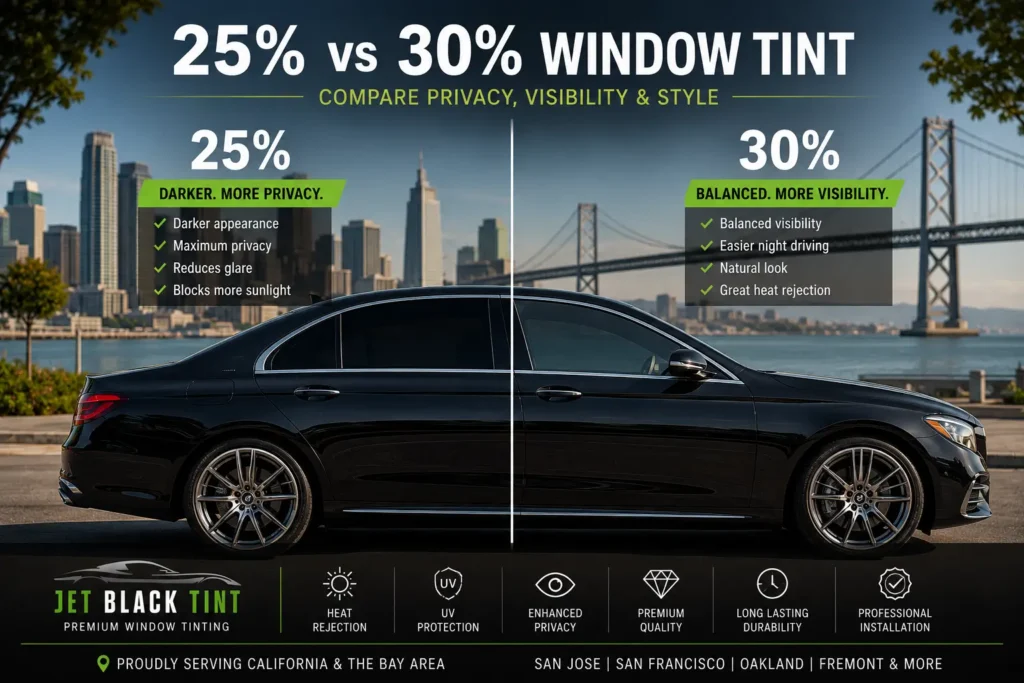
Even though the difference is only 5%, it is noticeable both from inside and outside the vehicle.
This impacts:
Yes—but not dramatically.
Compared to a jump like 15% vs 35%, the difference between 25% and 30% is more subtle.
From the outside:
From the inside:
For many drivers, the visual difference is noticeable but not extreme.
If you’re aiming for a darker premium look, 25% will edge out 30%.
Privacy is one of the top reasons people install window tint.
If your priority is keeping your cabin less visible from the outside, 25% tint performs slightly better.
This makes a difference when:
In busy urban environments like San Francisco or Oakland, privacy can be a practical benefit, not just a style preference.
That said, 30% still provides solid privacy.
The difference is not dramatic—but if privacy is your priority:
Winner: 25% Tint
Appearance is subjective, but many drivers care a lot about aesthetics.
25% tint creates:
30% tint creates:
For black vehicles, SUVs, and sportier builds, 25% often looks more dramatic.
For daily drivers or luxury sedans, many people prefer the slightly more refined appearance of 30%.
Neither is wrong—it depends on your style.
This is one of the most common misconceptions.
Darker tint does not automatically mean better heat rejection.
The real factor is film technology.
A premium ceramic 30% film can reject significantly more heat than a cheap dyed 25% tint.
This matters a lot in California heat, especially during long commutes or when parked outdoors.
For drivers in the Bay Area dealing with sunny weather and long daytime driving, choosing ceramic film matters far more than obsessing over a 5% shade difference.
Jet Black Tint offers stronger performance packages here:
👉 https://jetblacktint.com/199-window-tinting-special-offer/
If heat reduction matters most, prioritize film quality.
During daylight, both 25% and 30% are very manageable for most drivers.
However, 30% offers slightly better outward visibility.
This can make a difference when:
25% still remains practical, but feels just a bit darker.
If visibility comfort matters:
Winner: 30% Tint
Night driving is where small tint differences become more noticeable.
25% reduces visibility slightly more.
This can matter if you:
30% provides slightly better visibility while still maintaining a darker look.
For Bay Area commuters navigating evening traffic, bridges, tunnels, and urban roads, this can be important.
If nighttime practicality matters:
Winner: 30% Tint
California drivers face unique conditions.
Strong sun exposure, warm summers, UV damage, and daily commuting make window tint more than just a cosmetic upgrade.
If you’re in:
comfort matters.
Both 25% and 30% can work well—but pairing your chosen shade with high-quality ceramic film makes the biggest difference.
That combination delivers:
Bay Area conditions are unique.
Drivers often deal with:
Because of this, 30% often feels like the more practical all-around choice.
It still delivers privacy and style while preserving slightly better visibility.
Drivers prioritizing appearance may still lean toward 25%.
This is critical.
California tint laws regulate what’s allowed depending on window location.
Before choosing either option, review:
👉 https://jetblacktint.com/legal-tint
Choosing illegal tint can result in:
Bay Area drivers should be especially aware since enforcement can vary.
Always confirm legality before installation.
If you’re exploring tint for the first time, Jet Black Tint offers affordable options.
Budget-friendly option:
👉 https://jetblacktint.com/99-window-tinting/
For upgraded performance:
👉 https://jetblacktint.com/199-window-tinting-special-offer/
These options allow drivers to choose based on budget and performance goals.
Installing new tint over old damaged film is never recommended.
Common issues include:
Jet Black Tint offers:
👉 https://jetblacktint.com/free-full-tint-removal/
Removing old film ensures better adhesion and a cleaner final result.
Busy schedule?
Jet Black Tint also offers mobile installation.
👉 https://jetblacktint.com/mobile-tint/
This is ideal for:
Mobile tint makes the process much easier.
30% often feels more balanced.
25% provides stronger privacy.
25% tends to be popular for bolder styling.
Both work well depending on taste.
30% is often more practical.
If your priority is:
For many California and Bay Area drivers, 30% is often the smarter all-around daily choice.
But if you want a darker premium look without going too aggressive, 25% is a strong option.
Yes. Lower VLT means darker tint.
Noticeably darker, but not dramatically.
25% provides slightly stronger privacy.
30% offers slightly better visibility.
Not necessarily. Film quality matters more.
Often yes, especially for heat rejection.
Depends on the specific window and California regulations.
Check:
👉 https://jetblacktint.com/legal-tint
Yes.
Jet Black Tint offers:
👉 https://jetblacktint.com/free-full-tint-removal/
Yes.